INFO 371 ~ Learning and Shifting
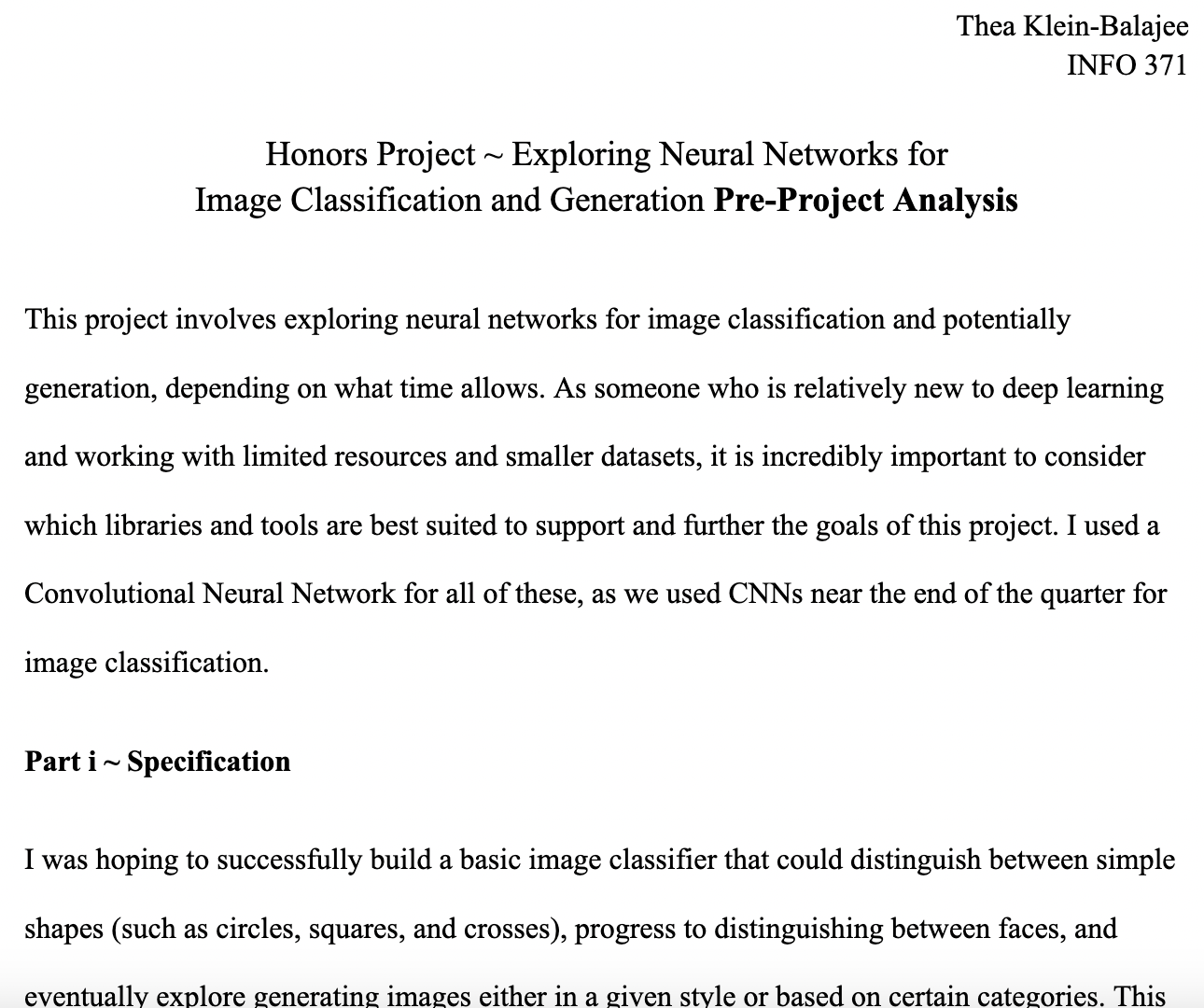
For my INFO 371 Honors Project, I explored neural networks for image classification and image generation. Coming into the project with limited experience in deep learning and working with relatively small datasets, I focused on Convolutional Neural Networks (CNNs) and, after a lot of research, selected libraries that would allow me to experiment while still building a basic foundation of knowledge on the topic.
I began with a controlled experiment by training a model to classify simple geometric shapes - circles, crosses, and squares. This early phase was intentionally easy, because I wanted to clearly be able to observe how neural networks learn visual features such as edges, shapes, and spatial patterns. Working with simple data helped me understand how CNNs process images and gave me confidence before moving on to more complex, real-world datasets.
Next, I shifted to facial recognition using the Labeled Faces in the Wild (LFW) dataset. This stage introduced significantly more complexity and taught me about challenges such as overfitting and dataset imbalance. My initial models performed poorly, but through preprocessing and hyperparameter tuning, I was able to improve performance. This process really showed me the importance of iteration for me and the idea that model development is rarely linear - it requires constant testing and adjustment.
Finally, I trained a model on butterfly images using a pretrained network. While the dataset still showed signs of overfitting, experimenting with this allowed me to achieve better results and understand how existing architectures can be adapted to new, creative domains.
Now for the honest part - while I recognize that this knowledge would be extremely valuable in a traditional data science role, I found myself increasingly conflicted about how AI, particularly image-based models, are typically trained and used. This experience clarified something important for me: I’m mainly motivated by creative problem-solving and design-driven work that does not involve working with AI or learning skills that would ultimately result in a higher salary, but are against what I stand for. Rather than pushing deeper into AI development, I want to work in roles where technology supports creativity, storytelling, and human or planet-centered experiences. This fits into my refinement section because it helped me solidify the idea that even if I have the knowledge to do something, I do not have to use it.